Someone Is Going to Lose › Notes › Six
NotesSix · The Pyramid
These are the notes as printed in the November 2026 edition. Links to the sources will be added to this page as they are checked; new events since the reporting ended on November 4, 2026 are on the updates page.
Insull’s speeches of 1914–1923 are cited from Public Utilities in Modern Life: Selected Speeches (1914–1923) (Chicago, 1924). “Cudahy and Henderson” is Richard D. Cudahy and William D. Henderson, “From Insull to Enron,” Energy Law Journal 26 (2005).
- The epigraph: Leland Rex Robinson, American trade commissioner in London, as quoted by Insull at Louisville, April 9, 1925; Insull’s restatement drops Robinson’s “strictly speaking.”
- New Albany and Jeffersonville, “$76.12,” “far from satisfactory,” the company “organized in 1912,” the “electrical districts,” “dusk to dawn,” “more properly an investment company; even more accurately perhaps, a development company,” twenty-six companies in fifteen states “from Maine to Texas,” 915 towns, more than half a million customers, “scores of them no service at all,” and “is exercised only to give the local company the advantages of large-company experience, ability, and financial resources”: Insull, How Has It Been Done?, National Electric Light Association, Louisville, April 9, 1925 (pamphlet). The investor who withdrew: International Directory of Company Histories, “PSI Resources.”
- Allen’s account of the founding, the Maine chain, the salesmen and the price, and the brokers keeping the market steady: Frederick Lewis Allen, The Lords of Creation (1935), chapter IX, read in a later summary; not checked against Allen’s pages.
- The $100 million illustration is the author’s, not a historical case.
- “half a billion dollars … less than $30 million”: Cudahy and Henderson, p. 59.
- “to put his eggs in more than one basket even though he has only one egg” and “doing a highly diversified business in diversified communities”: How Has It Been Done? The eggs in one basket at Fisk Street: Insull, University Club, Chicago, September 20, 1922.
- “We shall never stop talking about it” and “The interest charge is the largest single item in our operating cost”: Insull, Looking Forward by Looking Backward, Purdue, April 22, 1925 (pamphlet, 1926).
- The act of May 2, 1917, the first meeting at Springfield on May 8, and fifteen members without pay: Final Report of the State Council of Defense of Illinois (Chicago, 1919), pp. 7–9, with its roster. Lowden’s appointment: the 1924 volume’s notes. Citizenship in 1896: Wikipedia, “Samuel Insull.”
- The coal survey at the federal fuel administrator’s request and “about 21½ days’”: Final Report, pp. 216–217. “Two of the most terrific blizzards Chicago has had in thirty years”: Illinois in the War (below). The 100,000 tons and “the first duty that we had to perform was to see that the people were kept warm”: Insull, November 20, 1918.
- “a liquidating — almost a liquidated — concern,” “it organized the public mind,” and “patriotism is but a higher development of team-work”: Insull, Illinois in the War, Commercial Club of Chicago, January 18, 1919 (pamphlet), pp. 1–9; the pamphlet misprints “patriotism.”
- The borrowed idea, at first distasteful: the 1924 volume’s introduction, in its own words.
- “an absolute necessity with all of us,” the dose of his own medicine, and “four dollars to seven dollars of new capital”: Insull at the National Electric Light Association, Drake Hotel, Chicago, June 3, 1921.
- The Bond Men’s Club, Hotel La Salle, November 15, 1923: 1,065,422 shares, “860,000 odd shares,” “three and one-third shares,” ninety percent, “the answer to the demand for municipal ownership,” the reel of cable, “the very fellows who sent you to the capital,” “We need the money,” “a little more independent,” 130,000 and 34,000: Insull, “Modern Financial Problems of Utilities,” slightly abbreviated in the volume. Non-voting preferred: Cudahy and Henderson, p. 53.
- Samuel Insull Jr., born April 12, 1900; “more interested in arts and letters than in engineering” (Fortune, September 1931); the memorandum to Budd; June 29, 1925; “baling wire and chewing gum”; about $13 million; 247 and 650 percent; Feustel; and “All right, Junior, go ahead: good luck, gentlemen”: Shore Line Interurban Historical Society, First & Fastest, spring 2025, drawing on Fortune and the society’s records; not checked against Fortune. The voltage: Wikipedia, “Chicago South Shore and South Bend Railroad.” The 1923 post: the 1924 volume’s note.
- Gladys Insull’s return, spring 1925: The New York Times, May 23, 1925, via Wikipedia. The Little Theatre, October 22, 1925: Playbill Vault. Five weeks, $3.30, “petite and beautiful,” and the rest: Variety, November 4, 1925, read from a scan; not checked word for word.
- “Miss Gladys Wallis, an aging, hopelessly incompetent amateur” and Kaufman’s notice: Richard Meryman, Mank (1978), pp. 77–78, via Wikipedia, “Sources for Citizen Kane”; not checked against Meryman. The Chicago theater lease: Time Out Chicago; Classic Chicago Magazine.
- Smith’s commission post, the $125,000 in cash, $15,000 to Brennan, and the Senate’s 1928 resolution: Cudahy and Henderson, pp. 59–61. Brennan as an old friend, the summer testimony, and Reed’s “This utility giver is apparently out to land on both feet”: Time, August 9, 1926; not checked against the hearings.
- Caraway, the Reed committee, McKinley’s death, Smith’s appointment, January 19, 1927, the February refusal, the vote of 61 to 23, and the resignation: United States Senate Historical Office, “Frank L. Smith (1928).”
- “All of it was borrowed by me from the Commonwealth Edison Company,” $172,925.19, and the contempt motion: Associated Press, February 26, 1927, from a scanned page. “Other gifts besides those two”: the sum exceeds the $125,000 and $15,000 by $32,925.19; Cudahy and Henderson, pp. 59–61, put his primary giving at more than $238,000. “That is the reason why I declined to give the names at the former hearings”: Insull’s testimony to the Senate special committee investigating campaign expenditures, January 7, 1928. Norris’s remark: Congressional Record, vol. 68 (1927). The seven years: Emmet Penney, “Samuel Insull: Father of Light,” part IV, Foundation for American Innovation, October 2025, which gives no source for it.
- The opera’s losses, the guarantors’ $400,000 a year, “eventually,” and more than $20 million: Chicago Tribune, January 4 and 16, 1928, as transcribed at chicagology.com. The architects: Wikipedia, “Civic Opera Building.” Garden’s announcement of July 15, 1929: Edward Hagelin Pearson, The Opera Quarterly, 1995, via Wikipedia.
- Eaton’s buying, the voyage, “poised to mount a corporate raid,” the cost of a majority, “to perpetuate … the existing management of the Insull group of public utilities,” and the non-voting securities: Cudahy and Henderson, pp. 62–63, drawing on Forrest McDonald, Insull (1962). The formation in December 1928: The Wall Street Journal, December 29, 1928.
- January 17, 1929, $7.54, about $30, and $149 on August 2: testimony of Samuel Insull Jr., Senate Committee on Banking and Currency, Stock Exchange Practices, part 5, February 15, 1933, pp. 1397–1427. “Twenty times” and “thirty-seven years”: the author’s calculation.
- State Line, April 8, 1929, the three shafts, two tons of coal a minute, “the largest generating unit ever built,” and “only fifty years after the invention of the incandescent electric lamp”: American Society of Mechanical Engineers, landmark brochure, 1977, quoting the company’s 1929 booklet.
- “has gone a little ahead of the development of the community”: Insull, Greater Chicago (pamphlet, about 1925–26); the occasion is not identified in the copy read.
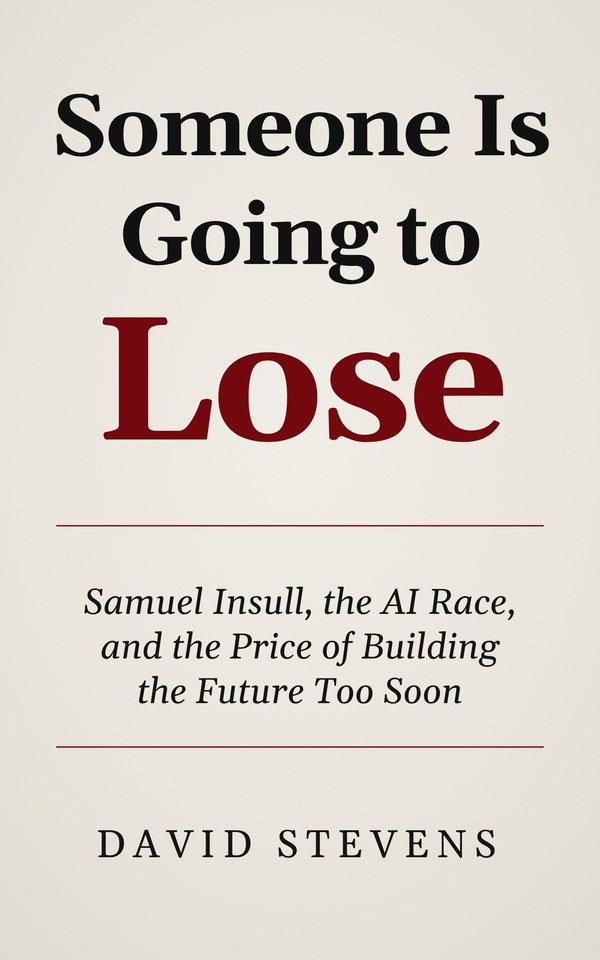
The book
Someone Is Going to Lose: Samuel Insull, the AI Race, and the Price of Building the Future Too Soon. In paperback, hardback and for Kindle.
View on AmazonAll the notes