Someone Is Going to Lose › Notes › Four
NotesFour · Every Time
These are the notes as printed in the November 2026 edition. Links to the sources will be added to this page as they are checked; new events since the reporting ended on November 4, 2026 are on the updates page.
- Hudson in the Commons on May 17, 1849, the petitions, and every word of his quoted on the page: Hansard, House of Commons, vol. 105, cols. 581–89. What the “domestic affliction” was is not recorded there.
- Hudson’s life, from Howsham to the blinds lowered in York: Robert Beaumont, The Railway King (2002), and A. J. Arnold and S. McCartney, George Hudson (2004), as summarized in the standard reference accounts; not checked against the biographies’ own pages. More than a thousand miles by 1844: Science Museum Group.
- The committees’ findings and the Eastern Counties’ overstated profits: MoneyWeek, “Great frauds in history: George Hudson.” The York and North Midland’s dividend of six percent and then nothing: the standard account from W. W. Tomlinson’s history of the North Eastern Railway.
- Miles authorized (91 in 1843, 4,538 in 1846), seven percent of national product in 1847, the cost and revenue shortfalls, the share index’s fall, £60 million expected against £15 million earned in 1852, about 2,200 and 6,900 miles, and the few bankruptcies: Andrew Odlyzko, “Collective hallucinations and inefficient markets” (2010), and “The Railway Mania,” Journal of the Railway & Canal Historical Society 215 (2012). “Well over two hundred Acts”: National Railway Museum. The fractions on the page are the author’s.
- The Brontës’ £300 each and Emily’s management: annebronte.org, September 27, 2020. Charlotte to Margaret Wooler, January 30, 1846, all quotations: as transcribed online, not checked against Margaret Smith’s edition of the letters. “The original price of shares in the railway was £50 …”: Charlotte to her publisher, George Smith, September 27, 1849. “Many—very many are—by the late strange Railway System deprived almost of their daily bread”: The Letters of Charlotte Brontë, vol. 2, p. 267, via Odlyzko (2012).
- Dickens, “throw up my head, and howl …”: letter to Count d’Orsay. Carlyle, “big swollen Gambler”: “Hudson’s Statue,” Latter-Day Pamphlets (1850). “commercially … great failures”: The Economist, 1855, via Odlyzko.
- The North Eastern Railway and York’s railway workers, 41 and 5,500: The York Historian, November 7, 2025.
- Odlyzko’s later turn to the history of the Railway Mania: his papers of 2010 and 2012, above.
- Winnick’s life, Drexel, the $55 million settlement, “Founder Escapes Charges in Global Crossing Failure” (Los Angeles Times, December 14, 2004), and his death: standard biographical accounts. Global Crossing founded in 1997 with about $35 million: the same; one account gives 1998.
- $19 a share: company release, August 17, 1998. The split: Royal Gazette, February 5, 1999. $61.81, the $94 million estate, “One little idea … and look what’s happened to me,” and the $734 million: New York Times News Service, March 3, 2002. “spent like a Roman emperor”: Julie Creswell, Fortune, December 24, 2001. A hundred thousand miles, no profit and $7 billion lost: BBC News, February 11, 2002.
- “UUNet estimates that network traffic is doubling every 100 days …,” “[t]raffic on the Internet has been doubling every 100 days,” Sidgmore, the true rates, the 1998 paper that “seemed to have no noticeable effect,” the $100 billion, Gilder’s “a truly cosmic position as the supplier of the missing element,” and “first became unable to comprehend compound interest”: Odlyzko, “Bubbles, gullibility, and other challenges …,” First Monday 15, no. 9 (September 2010). “Twelvefold a year” is the author’s arithmetic: 2 to the power of 3.65.
- “does NOT equal to the Internet traffic, even at that time!”: Jessica Yu, North American Network Operators’ Group list, August 2010, archived.
- “100 million miles,” “Only 5 percent of fiber in the ground is active” (attributed to no named source), and IDT’s $12 million to $1.8 million: New York Times News Service, June 18, 2001.
- The $123 million sale, the $360 million shortfall, and the chief executive’s notes: Light Reading, October 1, 2002; Rochester Business Journal, October 4, 2002.
- The bankruptcy of January 28, 2002: BBC News. $2 trillion and half a million jobs: Paul Starr, American Prospect, September 2002. Sidgmore’s death at fifty-two: FCW, December 12, 2003.
- The hearing, Capacity Swaps by Global Crossing and Qwest: Sham Transactions Designed to Boost Revenues?, September 24 and October 1, 2002, Serial No. 107-134: the printed record, whose October 1 pages have not been read in full. Greenwood’s two sentences, “not a result of fraud,” and “step up and write a check”: BBC News, October 1, 2002. Crumpler’s “I lost my entire 401(k) money—$86,000 …” and “That’s why I held on …”: Rochester Business Journal, October 4, 2002. “a catastrophe that befell an entire industry sector,” “We decided to pull the trigger in May,” “I do not have a recollection of that,” “were family,” “I’ve let them down,” “a little shy of $25 million,” and “This is not about money. It’s about people”: Light Reading, October 1, 2002. “guarantee” and “only pennies on the dollar”: CNN, October 3, 2002. Whether the $25 million was paid in full has not been established.
- VSNL, $130 million, “almost $2.5 billion,” and Mauldin’s “pennies on the dollar”: Business Standard, November 2, 2004.
- Netflix on Level 3: Data Center Knowledge, November 30, 2010. The purchase of Global Crossing, October 4, 2011: Level 3 release, filed with its Form 8-K. Which cables of 1998–2001 were still in service in 2011 has not been established.
- “The lines and the cables waited for their traffic and got it. Not everything built early does”: the author’s two sentences, resting on the North Eastern Railway, the Level 3 purchase and the canal’s record.
- Adams’s diary, July 4, 1828, all quotations: John Quincy Adams Digital Diary, Massachusetts Historical Society.
- The canal’s 341 miles and $22 million, Cumberland in 1850, seventy years of coal, and 1938: the standard account, from Harlan Unrau’s National Park Service history (2007).
- Carroll’s first stone and the railroad’s dates: National Park Service, “The Race to Ohio”; John F. Stover, History of the Baltimore and Ohio Railroad (1987).
The sentence “Between the dividend Hudson promised and the traffic that came, the gap was carried by whoever held the shares” is the author’s. The chapter gives no verdict on Hudson or Winnick.
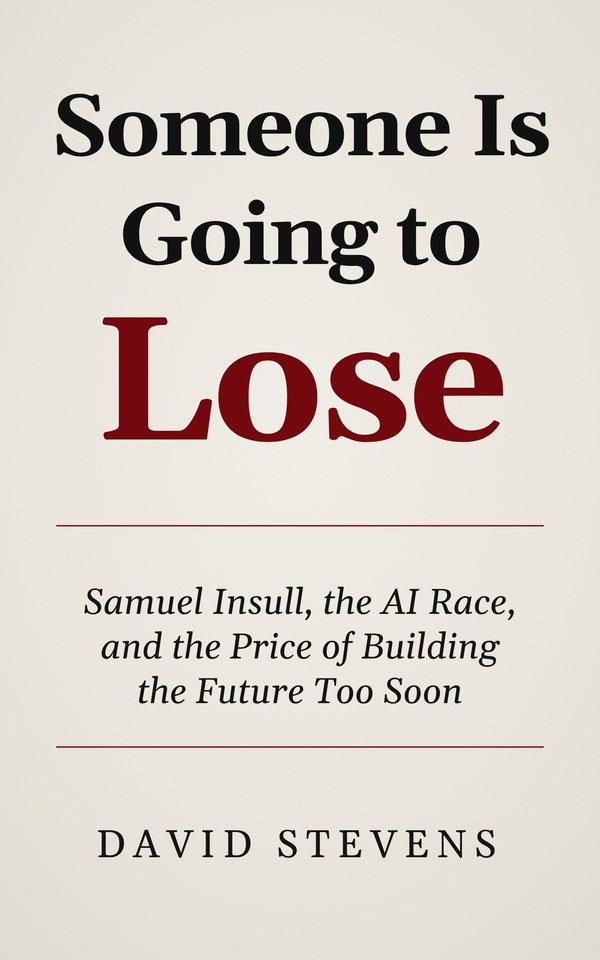
The book
Someone Is Going to Lose: Samuel Insull, the AI Race, and the Price of Building the Future Too Soon. In paperback, hardback and for Kindle.
View on AmazonAll the notes